


Revenue & Pipeline
Pipeline Quality Is Not A Marketing Metric
Pipeline quality is shaped by the offer, sales, positioning, pricing, follow-up, and what leadership chooses to celebrate.
 Robinson Recalde 6 min read
Pipeline quality is a commercial truth before it is a metric.
Marketing can influence it, but the whole commercial path shapes it. Sales shapes it. The offer shapes it. Pricing shapes it. Positioning shapes it. Follow-up shapes it. Leadership shapes it by what it celebrates.
When a company treats pipeline quality as a marketing metric, the conversation becomes too small. The team asks whether campaigns are producing enough leads. The better question is whether the company is attracting, qualifying, and advancing the right opportunities.
Volume can hide the answer.
More pipeline can make the problem worse
A weak pipeline is painful. A large weak pipeline is expensive.
It creates more meetings, more follow-up, more proposals, more forecasting noise, and more pressure on sales to turn poor-fit interest into revenue. The team feels busy, but the business does not feel clearer.
This is why "more leads" can be the wrong target. The company may not need more people entering the path. It may need fewer weak-fit people and a clearer reason for the right ones to move.

Quality comes from choices
Pipeline quality improves when the company makes choices upstream.
Who should see themselves in the offer? What pain should the market associate with the company? What proof should make the buyer trust the next step? What disqualifies an opportunity early? What language should sales use to protect fit?
Those questions sit upstream from campaign performance. If they stay vague, the campaign inherits the vagueness.
What to inspect
Start by looking at the opportunities that became real revenue.
- What did they believe before buying?
- What pain did they already feel?
- What proof mattered?
- What made timing clear?
- What made the first conversation useful?
Then compare that pattern to the opportunities that consumed time but did not move. The gap will teach the team more than a lead count.

Define quality before counting volume
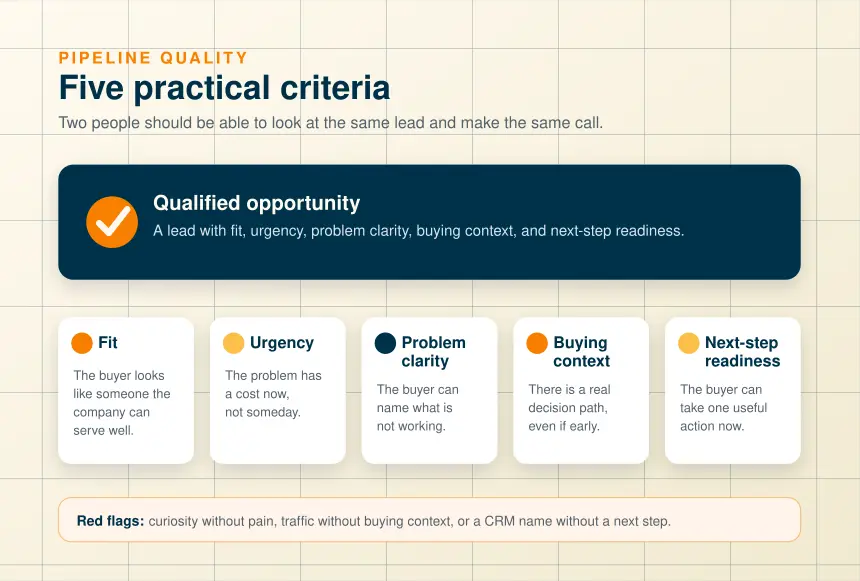
A qualified opportunity should be specific enough that two people on the team can look at the same lead and make the same call.
Use five practical criteria.
Fit: the buyer looks like someone the company can serve well. Urgency: the problem has a cost now, not someday. Problem clarity: the buyer can name what is not working. Buying context: there is a real decision path, even if it is early. Next-step readiness: the buyer can take one useful action without needing a full education first.
That definition also reveals the red flags. Curiosity without pain gives the team a conversation, not demand. Traffic without buying context gives the team movement, not pipeline. A name in the CRM without a next step is still only a record.
The practical move
Create a quality definition before increasing volume.
Write the traits of a qualified opportunity in plain language. Include fit, urgency, buying context, problem clarity, and next-step readiness. Then use that definition across content, campaigns, sales notes, and reporting.
Pipeline quality improves when the whole commercial team agrees on the signals that deserve time.
Continue Reading
You might be interested in



Kronek Insider
Get the next useful idea before it becomes obvious.
Leave your name and email to get practical notes on strategy, media, and commercial work from Kronek.