


Growth Operations
When Follow-Up Depends On Memory, Revenue Depends On Luck
Follow-up should protect buyer momentum. If the next step depends on who remembers, the commercial rhythm is too fragile.
 Robinson Recalde 6 min read
If follow-up depends on memory, revenue depends on luck.
That sounds harsh, but most companies know the feeling. A buyer shows interest. Someone intends to follow up. The week fills up. The message gets delayed. The context fades. The next step becomes less obvious than it was on the first day.
Momentum usually disappears in the gap between intention and ownership. Someone meant to send the note, but the next step was never made explicit enough to survive a busy week.
Memory makes follow-up fragile
Good people forget things when the work around them is noisy.
They forget because there are too many tools, too many channels, too many priorities, and too little clarity about what should happen next. They forget because urgency is uneven. They forget because the company has not defined what a good follow-up rhythm looks like.
The fix starts by making ownership visible enough that a good lead does not depend on the one person who happened to remember.

Follow-up should protect momentum
Follow-up protects the thread of the conversation.
A good rhythm reminds the buyer why the problem matters, gives them a reason to return, answers the next likely question, and makes the next action easy. It should sound like continuity, not pressure.
When follow-up is random, the buyer has to rebuild the thread every time.
What to decide
The team needs a few clear rules.
- What happens in the first hour after qualified interest?
- What context must be captured before anyone follows up?
- What message belongs after a first call?
- What proof should be sent when timing is unclear?
- When should the team stop following up?
Those rules do not need to be complicated. They need to be visible.
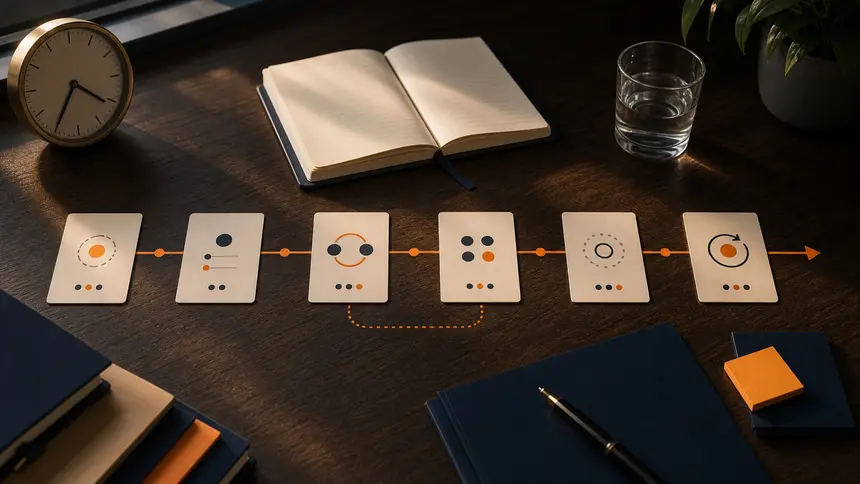
The rhythm should change by moment
The first response has one job: confirm the buyer was heard and make the next step easy.
The message after a first conversation has a different job: reflect the problem in the buyer's words, clarify what was learned, and show the decision in front of them.
The proposal follow-up should give the buyer something better than "Any thoughts?" It should help them compare the cost of waiting, the risk of moving forward, and the practical first move.
The stalled-decision follow-up should respect timing while keeping the problem visible. Reactivation should return with a reason, not a generic check-in.
The message gets sharper when the team knows what each moment is for.
The practical move
Build one follow-up path for one offer.
Write the moments that matter: inquiry, first response, first conversation, proposal, stalled decision, and reactivation. For each moment, define the owner, the timing, the message purpose, and the proof that belongs there.
Then test it. If the rhythm improves clarity, speed, or trust, expand it.
The revenue risk is simple: when memory owns follow-up, the buyer's momentum competes with everyone else's calendar.
Continue Reading
You might be interested in
Kronek Insider
Get the next useful idea before it becomes obvious.
Leave your name and email to get practical notes on strategy, media, and commercial work from Kronek.